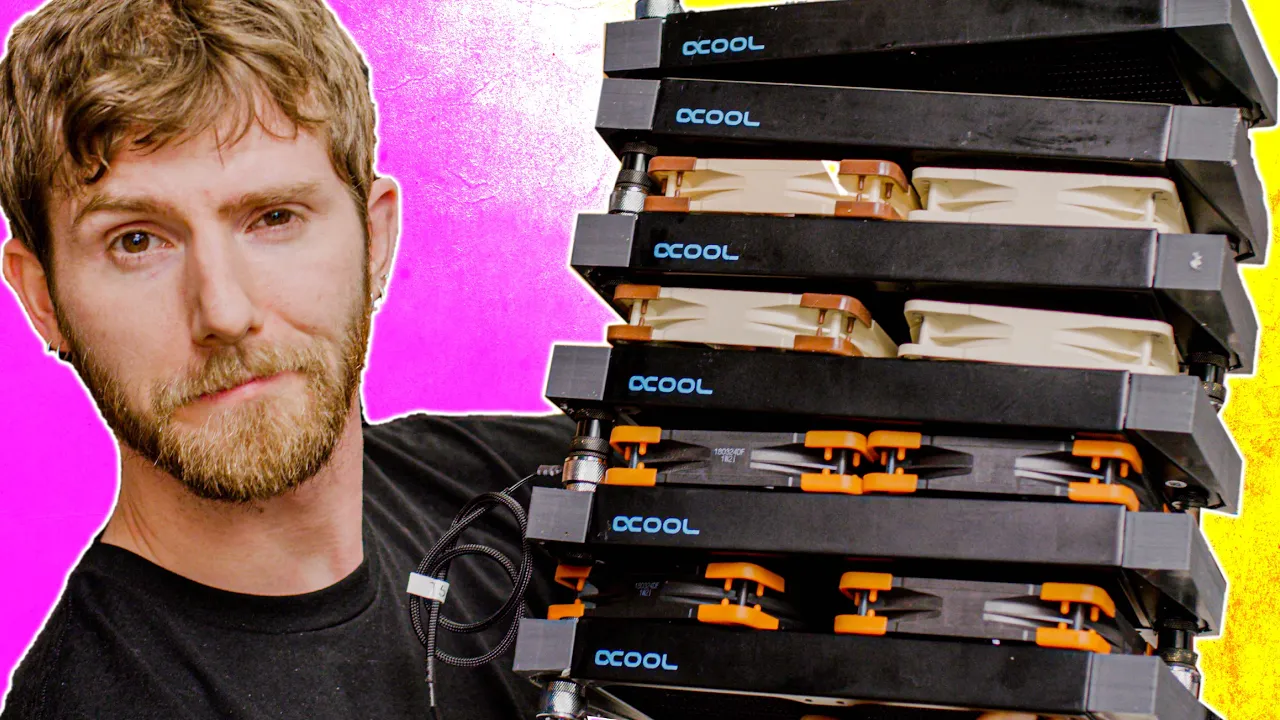
Is this even going to work…
0 up · 0 down · 0 ratings
Promos
Enter Ting's giveaway for your chance to win a Samsung Galaxy 10+ and more at mobile.ting.com Not to leave our viewers dissatisfied, we built a furnace of a PC, a wind tunnel with 7 radiators, and our own data logging system to find out once and for all the EXACT effects of stacking radiators on water temperature. Buy AMD Threadripper 3970X On Amazon (PAID LINK): geni.us On Newegg (PAID LINK): geni.us Buy Alphacool NexXoS ST30 Radiators On Amazon (PAID LINK): geni.us On Newegg (PAID LINK): geni.us Alphacool Temperature Sensor On Amazon (PAID LINK): geni.us On Newegg (PAID LINK): geni.us Buy Nvidia Titan V On Amazon (PAID LINK): geni.us On Newegg (PAID LINK): geni.us Buy Noctua NF-F12 On Amazon (PAID LINK): geni.us On Newegg (PAID LINK): geni.us Purchases made through some store links may provide some compensation to Linus Media Group. Discuss on the forum: linustechtips.com Arduino code is in forum post!
Check out learn.adafruit.com for a good guide on how to use a thermistor-based sensor. GET MERCH: lttstore.com SUPPORT US ON FLOATPLANE: floatplane.com LTX EXPO: ltxexpo.com AFFILIATES & REFERRALS --------------------------------------------------- Affiliates, Sponsors & Referrals: lmg.gg Get Private Internet Access VPN at lmg.gg Get a Mech Keyboard: geni.us NEEDforSEAT Gaming Chairs: geni.us Get a Displate Metal Print at lmg.gg Use code LINUSMEDIAGROUP on Epic Games Store: lmg.gg Get a 30-day free trial of Amazon Prime at lmg.gg Our Gear on Amazon: geni.us FOLLOW US ELSEWHERE --------------------------------------------------- Twitter: twitter.com Facebook: @LinusTech Instagram: @linustech Twitch: twitch.tv FOLLOW OUR OTHER CHANNELS --------------------------------------------------- Techquickie: lmg.gg TechLinked: lmg.gg ShortCircuit: lmg.gg LMG Clips: lmg.gg Channel Super Fun: lmg.gg Carpool Critics: lmg.gg MUSIC CREDIT --------------------------------------------------- Title: Laszlo - Supernova Video Link: youtube.com iTunes Download Link: itunes.apple.com Artist Link: soundcloud.com Outro Screen Music Credit: Approaching Nirvana - Sugar High youtube.com Monitor And Keyboard by vadimmihalkevich / CC BY 4.0 lmg.gg Mechanical RGB Keyboard by BigBrotherECE / CC BY 4.0 lmg.gg Mouse Gamer free Model By Oscar Creativo / CC BY 4.0 lmg.gg
Paragraph 1: The video documents a thorough engineering investigation into radiator stacking for water cooling in a PC, building on prior claims that stacking radiators is ineffective. Colin and Linus design and fabricate a wind tunnel-like test rig with seven 240mm crossflow radiators and a matrix of temperature sensors to capture precise delta T values across each radiator inlet and outlet. They implement a custom data logger using an Arduino Due, enabling sensor readings every 250 milliseconds and real-time data processing with Steinhart-Hart thermistor calculations. The team also calibrates each sensor with trim pots to account for resistance variations, ensuring the raw data from the sensors maps accurately to actual temperatures. The setup is described as a “furnace of a PC” intended to reveal exactly how stacking radiators affects water temperature across the loop. This paragraph sets the stage for a controlled, transparent scientific test rather than anecdotal claims.Paragraph 2: The video then details the measurement methodology and data pipeline, including how the seven radiators are sequenced in a serial flow configuration, and how sensors capture inlet and outlet temperatures to determine delta T for each radiator. They discuss the practical challenge of data accuracy across multiple sensors and how they route data to a laptop via PuTTY for logging into a single text file for later analysis. The team explains the rationale for testing both forward and reverse flow configurations, using a controlled wind tunnel where air moves across the radiators, to assess how flow direction and radiator ordering influence heat transfer and soak. They emphasize that the experiment focuses on real-world, non-ideal conditions like airflow and heat soak, rather than a purely theoretical model.Paragraph 3: The results section compares multiple scenarios, first with seven radiators in a single flow path and then with a reversed flow, showing that the front radiator does most of the work and that heat soak causes downstream radiators to reheat the water. They observe diminishing returns after about radiator six, with the middle radiators eventually equalizing in temperature, and they note that reversing flow slows the rate at which the stack heats water, producing modest but measurable improvements. The analysis highlights that while more radiators can offer some gains, the overall benefit depends on adequate airflow and the correct arrangement of radiators and fans. They conclude that unlike the initial strong claims, stacking radiators is not universally beneficial, but can yield gains under properly configured cooling loops. The video closes with practical takeaways, a nod to the sponsor Ting, and directions to the related Hack Pro series for additional context and future testing opportunities. Paragraph 4: Across the full narrative, the presenters emphasize the scientific value of testing with controlled variables, acknowledging that some perceived gains in radiator stacking may come from flawed testing or insufficient time for the system to reach equilibrium. They admit to being surprised by the results, particularly the limited benefits of adding a second radiator under certain configurations, while also recognizing that correctly oriented airflow and mixed air streams can still yield measurable improvements. The framing is candid, with the hosts conceding lessons learned and inviting viewers to consider the nuanced interplay of airflow, thermal mass, and radiator surface area. The piece ends on a constructive note, encouraging continued experimentation and promising more data and demonstrations in future videos, alongside a mention of Ting’s giveaway and a prompt to subscribe for further test rigs and analyses.
Topics · science · technology · hardware · experiments · data logging · cooling · testing · wind tunnel
Questions answered
- What did the test rig aim to prove about radiator stacking?
- The test rig aimed to determine the exact effects of stacking radiators on water temperature by measuring inlet and outlet temperatures across a serial chain of radiators in a wind tunnel setup, including both forward and reverse flow configurations.
- How was data collected and calibrated for accuracy?
- A custom data logger built around an Arduino Due sampled every 250 milliseconds, with thermistor sensors calibrated using trim pots to align readings to known temperatures, and data was exported via serial to a text file for analysis.
- What was a key takeaway about the effectiveness of adding more radiators?
- More radiators do not always yield better cooling; effectiveness depends on airflow, timing to reach equilibrium, and proper configuration, though some benefits can be observed with correctly arranged stacks.