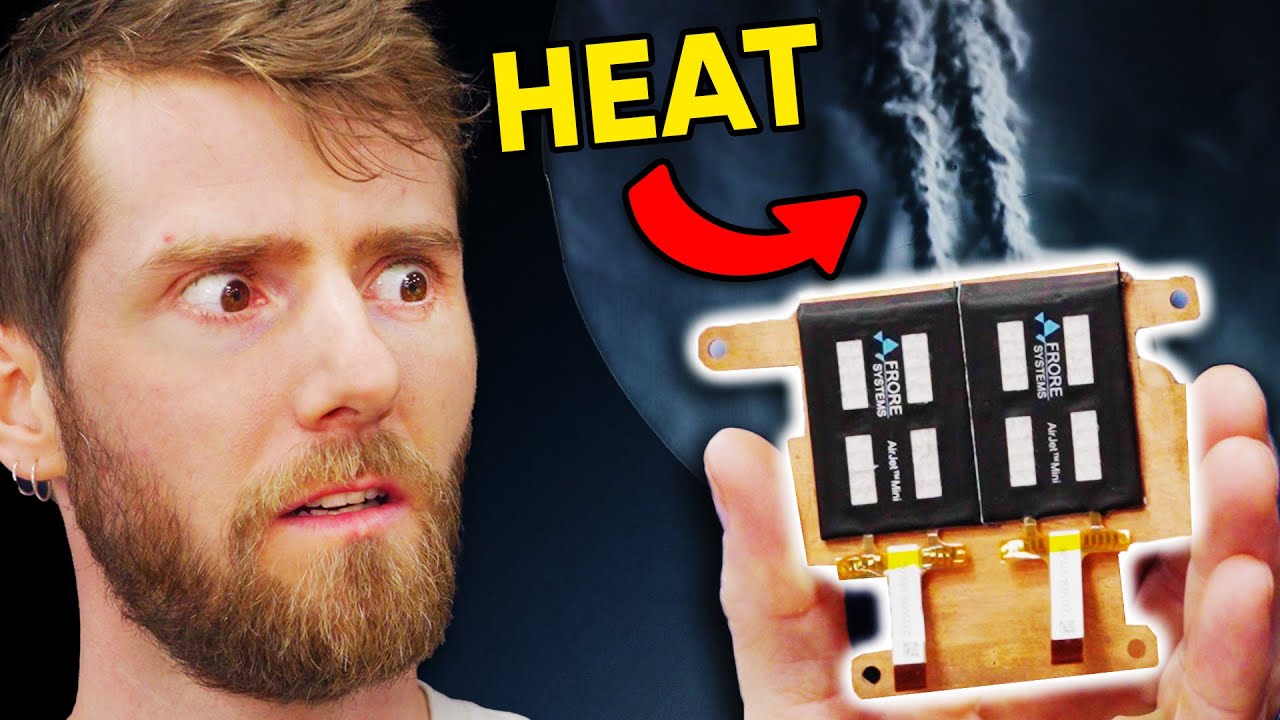
The Most Exciting PC Hardware in YEARS. - Frore AirJet Cooler
0 up · 0 down · 0 ratings
Promos
Get hooked up with the latest and greatest audio gear at lmg.gg Get 69% off any of XSplit’s video tools. Use code LINUS at lmg.gg It ain't much to look at but Frore System's Airjet cooling inventions could revolutionize PC cooling in the next few years. Here at Computex 2023, they're showing of a new version we've never seen before! Discuss on the forum: linustechtips.com ► GET MERCH: lttstore.com ► LTX 2023 TICKETS AVAILABLE NOW: lmg.gg ► GET EXCLUSIVE CONTENT ON FLOATPLANE: lmg.gg ► SPONSORS, AFFILIATES, AND PARTNERS: lmg.gg ► EQUIPMENT WE USE TO FILM LTT: lmg.gg ► OUR WAN PODCAST GEAR: lmg.gg FOLLOW US --------------------------------------------------- Twitter: twitter.com Facebook: @LinusTech Instagram: @linustech TikTok: @linustech Twitch: twitch.tv MUSIC CREDIT --------------------------------------------------- Intro: Laszlo - Supernova Video Link: youtube.com iTunes Download Link: itunes.apple.com Artist Link: soundcloud.com Outro: Approaching Nirvana - Sugar High Video Link: youtube.com Listen on Spotify: spoti.fi Artist Link: youtube.com Intro animation by MBarek Abdelwassaa @mbarek_abdel Monitor And Keyboard by vadimmihalkevich / CC BY 4.0 geni.us Mechanical RGB Keyboard by BigBrotherECE / CC BY 4.0 geni.us Mouse Gamer free Model By Oscar Creativo / CC BY 4.0 geni.us CHAPTERS --------------------------------------------------- 0:00 Intro 0:53 don't judge a book by its cover 1:41 Let's take it apart 3:21 Boundary Layers 4:20 How much cooling do you get? 5:19 Thermal Camera 6:13 Its 2nd big party trick 7:04 Dust resistance & why it's cool 8:58 How do they achieve this?? 11:44 The downsides... 12:31 Frore's Roadmap 13:23 Other applications 14:19 What could this mean for the future? 16:45 Outro
The video dives into Frore Systems’ AirJet cooling technology, starting with the surprise of a stealthy reveal and the bold claim that this solid‑state cooling approach could redefine PC cooling in the near future. The host disassembles a Frore AirJet module to show its core components, highlighting a flat copper base, a set of intake paper filters, a slim 2.8 millimeter cooling plate, and a back exhaust. He emphasizes that moving air is only half the battle, since the real challenge is heat removal at the surface interface, which their impingement jet architecture seeks to address. The narration then explains the cooling engine, where 80 small openings on the underside release high‑velocity jets, designed to obliterate the boundary layer and dramatically increase heat transfer efficiency. The discussion also introduces the idea that higher air speed can be achieved without bulky fans, thanks to the system’s high static pressure and its ability to push air through restricted openings. The segment concludes by tying these mechanisms to practical outcomes, such as a 15‑watt CPU cooling example in a Zotac ZBox Pico and how this approach could enable thinner, fanless or near‑fanless devices while maintaining performance. In the middle sections, the host elaborates on how Frore’s boundary‑layer solution translates to real world gains. He explains that the AirJet Mini can deliver roughly 10 times the static pressure of a typical laptop cooler, enabling air to be drawn through tightenth openings and across the entire device, not just the CPU. A thermal camera demonstration shows the exhaust temperatures and helps explain why, paradoxically, the Frore system can run hotter on the surface while keeping core components cooler due to more effective heat removal and management. The discussion expands to dust resistance, with the AirJet module housing its own dust filters and even a built‑in self‑cleaning option, which could significantly extend the life of compact devices in dusty environments. The host also notes the strength of using a photolithography manufacturing approach and the need for new materials and tools to scale production, acknowledging tradeoffs such as noise characteristics and higher unit costs compared to traditional fans. As the segment progresses toward implications and future roadmap, the host shares Frore’s plans for higher performance variants, including a dual‑AirJet Mini setup that could support up to 15 watts of CPU cooling in a portable chassis when paired with an effective heat spreader or vapor chamber. He envisions configurations with multiple AirJets along the back of a laptop, enabling substantial performance gains without sacrificing slim form factors, and even considers novel applications beyond PCs, such as LED lighting fixtures and cooled IoT devices. The discussion closes with a broader look at the potential revolution in mobile and compact compute, where efficiency and cost conundrums could eventually be addressed through scale and new manufacturing techniques, hinting at a future where fans could become obsolete in some devices while maintaining safe operating temperatures. The host teases ongoing experiments and future videos that compare this tech directly against conventional cooling methods and explores its real‑world viability across devices.
Topics · technology · hardware · cooling_technology · laptops · consumer_electronics
Questions answered
- What is the Frore AirJet cooling technology based on and how does it work?
- AirJet uses piezoelectric elements to generate high velocity jets through a distributed array of impingement nozzles. These jets disrupt the boundary layer on a heat sink surface, dramatically increasing heat transfer efficiency for the same airflow and enabling effective cooling in very thin form factors.
- What are the main practical benefits demonstrated, and what tradeoffs are noted?
- Benefits include high static pressure for better cooling through restricted passages, reduced reliance on bulky fans, dust resistance through integrated filters, and potential multi‑device cooling with compact modules. Tradeoffs discussed include higher manufacturing costs, potential noise due to jet dynamics, and the need for optimized device architecture to minimize turbulence and maximize efficiency.
- Could Frore AirJet technology be adopted in mainstream devices like the Steam Deck or laptops?
- Yes, there is strong interest in mainstream adoption, with discussions about integrating multiple AirJet modules into laptops and even upgrading handhelds. Real‑world feasibility will depend on manufacturing cost, system integration, heat spreading hardware such as vapor chambers, and how well the noise and power characteristics can be managed in consumer products.
- What are the roadmap and future directions mentioned for Frore AirJet?
- The roadmap includes higher performance variants such as a dual or larger AirJet configuration capable of removing more heat with similar or slightly higher power, broader applications including LEDs and IoT devices, and ongoing improvements in materials and manufacturing to reduce costs and enable scalable production.