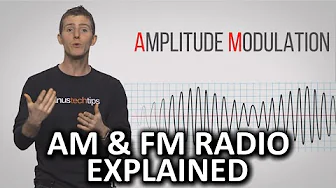
AM and FM Radio As Fast As Possible
0 up · 0 down · 0 ratings
Promos
AM & FM radio have been around since way before the digital age. How can radios decode AM & FM signals only using analog technology? Freshbooks message: Head over to freshbooks.com and don’t forget to enter Tech Quickie in the “How Did You Hear About Us” section when signing up for your free trial. Follow: twitter.com Join the community: linustechtips.com
AM and FM radio have distinct technologies for encoding audio, and this video walks through how each type of modulation works using simple analog concepts. It starts by contrasting AM and FM, explaining that AM changes the amplitude of a carrier wave to encode sound, while FM changes the frequency. The host describes how tuning a radio to a station frequency makes the antenna resonate and how the radio’s internal filters extract the desired signal from the airwaves. He emphasizes that the AM and FM processes are entirely analog, relying on physical components rather than digital decoding. The video then delves into why FM typically sounds clearer and louder due to its greater bandwidth and better resistance to amplitude-based interference, while AM can travel farther and wrap around terrain thanks to longer wavelengths and ionospheric reflection at night. The discussion concludes by weighing the practical advantages of analog radio, such as low cost and reliability, against the improvements offered by digital broadcasts, while also noting the enduring relevance of simple radios for basic communication and emergencies. The latter portion also includes a plug for FreshBooks, illustrating how the channel blends educational content with promotional messaging and viewer engagement prompts.
Topics · science · technology · education · communications
Questions answered
- What is the fundamental difference between AM and FM in how they encode audio signals?
- AM encodes audio by modulating the amplitude of the carrier wave, while FM encodes audio by modulating the frequency of the carrier wave.
- Why can AM signals travel farther at night than FM signals?
- AM signals can reflect off the ionosphere at night, enabling long-range propagation beyond line of sight, whereas FM signals are less affected by ionospheric reflection and tend to travel shorter distances.