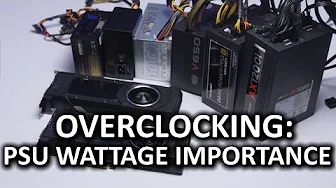
Overclocking Recommendations - Low vs High Wattage Power Supplies
0 up · 0 down · 0 ratings
Channels and socials
Do you need a 1200 watt power supply to overclock your shiny new or lightly used processor or video card? Or will a tiny 350 watt unit be enough? Cooler Master link: linustechtips.com Massdrop link: dro.ps Giveaway link: linustechtips.com Pricing & discussion: linustechtips.com Support us: linustechtips.com Join our community forum: bit.ly twitter.com @LinusTech Intro Screen Music Credit: Title: Laszlo - Supernova Video Link: youtube.com Outro Screen Music Credit: Approaching Nirvana - Sugar High youtube.com
This video conducts a controlled thought experiment on how much wattage a power supply truly needs for overclocking, using a range of PSUs from 300 W up to 1200 W. The host builds a test bench around an Asus X99 Deluxe with a 5960X CPU and a selection of graphics cards, then uses IDA64 and FurMark to push the components to their limits while monitoring power draw. The experiments begin with a very low wattage 300 W SFX unit from Silverstone, which surprisingly handles a 5960X and a mid-range GPU under stress, but ultimately fails when CPU clocks rise above 4 GHz. The results show that while the small PSU can power some overclocks, stability drops as clocks are pushed higher, illustrating that insufficient headroom can throttle performance or crash the system during aggressive overclocking. The test then scales up to larger units, including a 450 W SFX Gold, a 550 W unit, and progressively higher wattage PSUs, observing how each handles both CPU and GPU overclocking pressures. As the wattage increases, the systems generally sustain higher clocks, but the gains taper off when the components reach their inherent overclocking limits, indicating that extra wattage beyond a certain point provides diminishing returns. The video concludes that while more wattage can help when the system is bottlenecked by power, a surplus of power does not automatically translate to higher achievable overclocks, and efficiency and thermals remain important considerations. The host notes that, beyond a certain threshold, efficiency and long term reliability should guide PSU choice, and teases future videos on power setup optimization and cable management. Overall, the results emphasize practical guidelines: match power supply capacity to the system’s needs, consider headroom for stability, and avoid overspending on wattage when it does not translate to performance gains.
Topics · computer_hardware · hardware · overclocking · power_supply · technology · lab_testing