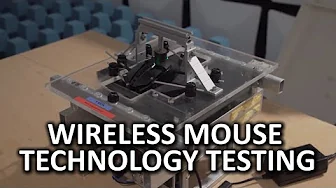
Wireless Mouse Technology Testing at the Logitech Daniel Borel Innovation Center
0 up · 0 down · 0 ratings
Description
This video was sponsored by Logitech. Logitech brought Luke out to the Daniel Borel Innovation Center to
Channels and socials
check out some of their tests around wireless mouse technology! Pricing & discussion: linustechtips.com Support us: linustechtips.com Join our community forum: bit.ly twitter.com @LinusTech Intro Screen Music Credit: Title: Laszlo - Supernova Video Link: youtube.com iTunes Download Link: itunes.apple.com Artist Link: soundcloud.com Outro Screen Music Credit: Approaching Nirvana - Sugar High youtube.com Sound effects provided by freesfx.co.uk Sponsored by Logitech.
Logitech’s wireless mouse technology testing is presented as a rigorous, multi-faceted evaluation of how wireless mice perform under extreme interference and non-ideal conditions. The video begins with an overview of the G900 Chaos Spectrum in a specialized RF lab setup, where the team constructs an anooic chamber to isolate signals from RF, Wi-Fi, and Bluetooth noise. They explain the importance of wireless performance by simulating worst-case environments, using a high-density LAN signal source and dense foam barriers to prevent signal bouncing, and then observe how the mouse tracker responds to the stimuli. The setup includes a jogger that moves a pad beneath the mouse sensor to ensure continuous triggering, while a receiver sits across the room connected to measuring equipment that tracks cursor movement. The host contrasts the G900’s performance with other mice like the Mamba 2015, Oraoros, Orbus, and Sensei, noting how each device responds to amplified interference in terms of stability, drift, and signal integrity. Overall, the segment emphasizes that a well-designed RF system and thoughtful hardware placement can deliver consistent tracking even in hostile wireless environments, a condition where many competitors struggle. By the end of this section, it is clear that the G900 sets a high bar for wireless latency under adverse conditions, while other mice reveal varying degrees of vulnerability to interference, advancing the narrative that wireless gaming mice can rival wired performance with the right engineering. The takeaways frame a broader point: simulator-driven RF testing paired with real-world measurements is essential for iterative, consumer-ready wireless device development, highlighting the role of RF simulators in achieving reliable, repeatable results without building new hardware for each test cycle.
Topics · technology · hardware · product-testing · wireless-technology