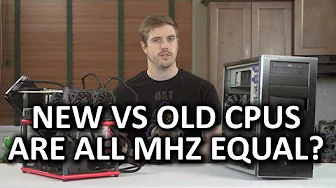
Are All MHz Created Equal? - Intel 5960X vs Q6600 Comparison
0 up · 0 down · 0 ratings
Channels and socials
Does an improvement in IPC (instructions per clock) actually amount to an imporvment in overall performance? Crunchyroll link: crunchyroll.com Cooler Master link: linustechtips.com Pricing & discussion: linustechtips.com Support us: linustechtips.com Join our community forum: bit.ly twitter.com @LinusTech Intro Screen Music Credit: Title: Laszlo - Supernova Video Link: youtube.com Outro Screen Music Credit: Approaching Nirvana - Sugar High youtube.com
The video examines whether megahertz are truly equal across CPUs, focusing on IPC (instructions per clock) and its real-world impact. The host notes that Intel has historically claimed around 10% IPC improvements with each generation, but questions whether these gains translate into meaningful performance in everyday tasks. To explore this, two systems are pitted against each other: a Q6600 at 2.4 GHz with four cores and no hyperthreading, paired with 8 GB of RAM and a GTX 980, and a 5960X configured to 2.4 GHz with four cores and no hyperthreading, also with 8 GB RAM and the same GPU. The goal is to control for clock speed and core count while observing how IPC, memory subsystem, and architecture affect both synthetic benchmarks and real-world gaming. The host emphasizes using seven benchmarks, plus several games, to assess throughput, latency, and frame-rate consistency across workloads. The conclusion hints that processor improvements can be more drastic than what raw specs suggest, and that upgrading may not always be necessary for all users, especially if overclocking or balancing other components is feasible. Overall, the video argues that clock speed alone does not determine performance and encourages viewers to consider IPC and system balance when evaluating CPUs. The middle portion of the video presents concrete benchmark and gaming results. Cinebench R15 shows a notable improvement when moving from the older Q6600 to the newer 5960X, roughly a 55% increase in a representative multi-threaded score. In contrast, certain synthetic tests like 3DMark and 7zip show more modest differences, with the newer CPU sometimes only edging out its predecessor. When shifting to real-world gaming, the differences become more nuanced: Tomb Raider appears GPU-bound with minimal CPU impact, while Far Cry 4 reveals a clearer gap where the 5960X maintains higher average and more stable minimum frame rates. City Skylines demonstrates a pronounced CPU dependency, exposing stutter and heavy GPU load on the older platform, whereas the 5960X manages smoother performance. The segment closes by advising viewers that for many users the best path may be to optimize settings, consider overclocking, or accept that not every game will leverage newer cores equally, reinforcing that performance is workload dependent. The final analysis underlines practical takeaways: if you are satisfied with your current processor, there is often little incentive to upgrade solely for incremental IPC gains. For speed enthusiasts, however, architectural improvements can yield noticeable benefits in CPU-heavy tasks and certain titles. The presenter also hints at broader discussion topics, such as how core count and memory architecture influence performance, and encourages exploration of overclocking and balanced system configurations as ways to maximize responsiveness without chasing every new-generation CPU. The video also interleaves promotional and community-building elements, including a light-hearted intro nod to a popular show, references to Crunchyroll, and invitations to engage with the forum and merchandise, all framed around the core hardware testing narrative.
Topics · Technology · Computer Hardware · Benchmarking · Gaming
Questions answered
- Do IPC improvements consistently translate into better real-world performance?
- IPC improvements generally contribute to better performance, especially in CPU-bound tasks, but the magnitude depends on the workload and system balance.
- Which CPU performed better in gaming according to the video?
- The newer 5960X showed stronger performance in CPU-bound scenarios and certain games, while some titles remained GPU-limited, reducing the observable difference.
- Why were games like Tomb Raider not ideal for CPU benchmarking in this test?
- Tomb Raider tends to be GPU-bound, so CPU differences have little impact on its performance, making it less informative for CPU-centric benchmarking.