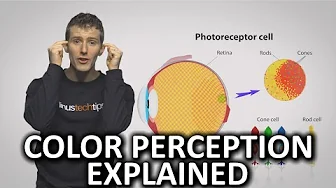
Why Do People See Colors Differently?
0 up · 0 down · 0 ratings
Description
Did you know that two different people can look at the same monitor and see different colors? How and why does this happen? Freshbooks message: Head over to freshbooks.com and don’t forget to enter Tech Quickie in the “How Did You Hear About Us” section when signing up for your free trial. Follow: twitter.com Join the community: linustechtips.com Thanks to Tyler from SpectraCal for giving us an assist with this episode.
In this DigiTech Quickie, the host explains why two people can look at the same monitor and perceive colors differently. The core idea is that human color perception hinges on cone cells in the eye, of which there are three main types sensitive to red, green, and blue light. Because individuals can have slight variations in cone composition, their sensitivity to the same wavelengths varies, leading to different color experiences even when viewing the same display. The video connects this to the RGB model used by most screens, noting that monitors must translate color information into red, green, and blue light, which aligns with how our cones respond but does not map perfectly across all viewers. It then traces how 1931 baseline color measurements have shaped modern color science and how contemporary flat panel displays show different energy distributions across the color channels, further complicating uniform color reproduction. The host discusses how newer projection tech and specialized primaries attempt to smooth out disparities by distributing energy across more base colors, while acknowledging that individual eye differences and backlight types keep the problem ongoing. The episode concludes with lighthearted notes about color debates, and credits a color expert for insights, before segueing into a plug for an accounting tool. The overall message is that color vision is a mix of biological variance and device limitations, making perfectly uniform color across people and screens elusive. Finally, practical implications for calibrating displays and understanding why friends may see colors differently are highlighted, underscoring the ongoing nature of color science research and display technology development.
Topics · science · technology · color science · display technology
Questions answered
- Why do two people see colors differently on the same monitor?
- Differences arise from natural variations in cone cell composition in the eyes, which affects sensitivity to red, green, and blue light and consequently color perception across individuals.
- What is metameric failure and how does it affect color on displays?
- Metameric failure occurs when two colors appear matching under one viewing condition but look different under another due to varying spectral energy distributions across displays and lighting.