The Recession's Already Here… Open Your Eyes
0 up · 0 down · 0 ratings
Channels and socials
If the economy looks fine on paper, then why does it feel like everything is quietly falling apart? And that's because the recession isn't coming. It's already here. The data just hasn't caught up yet. In this video, I'll break down: • Why recessions are always declared retroactively • Why record credit card debt and a collapsing savings rate aren't accidents • The shift happening in our economy • How the official numbers are designed to hide what's actually happening Complex topics, simple breakdowns. Join my free weekly newsletter to stay ahead of what's actually happening in markets: casualmarkets.co All illustrations, visuals, and animations in this video are original and hand-drawn by a freelance artist. Disclaimer: The information provided in this video and on this channel (collectively, the “Content”) is for informational, educational, and entertainment purposes only and does not constitute investment, financial, legal, or tax advice, nor a recommendation to buy, sell, or hold any security or investment strategy. Investing involves risk and you must do your own research. Nothing in the Content should be interpreted as creating a fiduciary relationship, financial advisory relationship, or client relationship of any kind. The host, the channel, and all affiliated entities expressly disclaim any and all liability for any direct or consequential loss or damage arising directly or indirectly from the use of, reliance upon, or interpretation of the Content. By viewing or interacting with the Content, you acknowledge and agree to these terms and release the host and all related parties from any and all claims related to your reliance on the information provided. #economics #finance #recession #investing
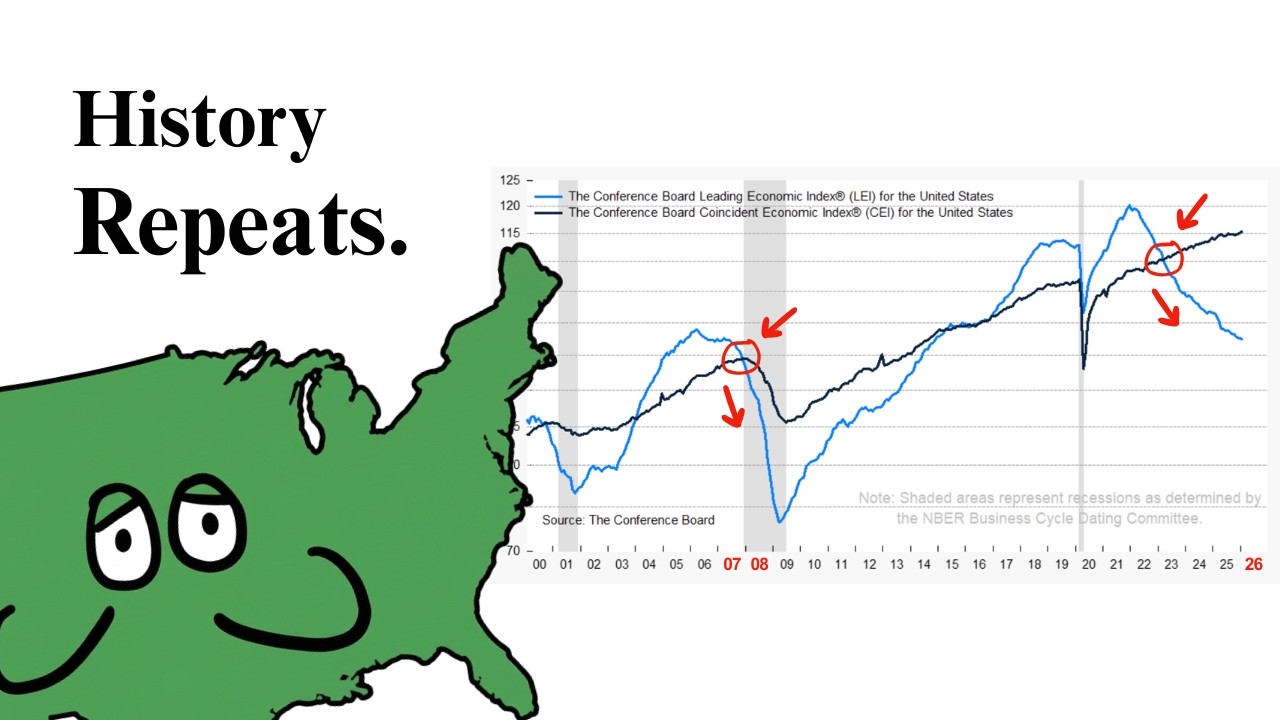
The video argues that the economy can look “fine” in headline data while a recession is already underway in people’s lived experience. It points to the National Bureau of Economic Research (NBER) declaring recessions retroactively, after collecting comprehensive data, typically 6 to 18 months later. As examples, it cites the 2008 global financial crisis, where recession dating is described as starting in December 2007 but not being declared until December 2008, and the 2001 dot-com recession, described as beginning in March but not declared until November. The video then contrasts the unemployment rate at about 4.4% with what the measure misses: unemployment statistics count only people actively looking for work within the last four weeks, while more than 1.6 million Americans are described as having stopped looking since the pandemic. It also adds that labor force participation is down nearly 1.5% versus pre-pandemic levels, suggesting a “drift” away from the statistics even if headlines stay positive. From there, the video claims the labor market is deteriorating in ways that official reporting understates, including a shift from full-time jobs toward part-time work. It says full-time roles are disappearing, part-time gigs are increasing, and that labor market accounting can mask this change, with 2025 described as showing 181,000 net new jobs alongside 4.4 million Americans working part-time because they cannot find full-time work. The video frames this as financial stress rather than comfort, noting that real income is described as stagnating while cumulative inflation is described as rising over 25% since 2020. It then ties the “borrow to cover basics” story to consumer credit, citing credit card debt reaching a record 1.28 trillion at the end of 2025 and an average credit card interest rate around 22%, alongside a personal savings rate dropping from around 8% historically to 4.5% now. The video connects these patterns to pre-recession behavior and adds corporate signals, including commercial bankruptcies rising over 7% to more than 24,000 filings, while describing a leading economic index that has declined for six consecutive months. Finally, the video argues that the gap between official numbers and real conditions is structural, not accidental, and uses Goodhart’s Law to explain it. It says methodologies can create “blind spots,” such as unemployment rate reporting that buckets anyone working as employed even if it is just minimal hours, and GDP counting credit-driven spending the same as income-driven spending. It claims that when metrics become targets, systems optimize for the number rather than the underlying reality, causing economic indicators to drift farther from what people experience. The conclusion urges viewers to look beyond headlines by questioning job quality, checking wage growth against inflation, and examining credit use when consumer spending appears strong, framing the NBER’s eventual official declaration as likely to confirm trends already visible in the “real economy.”
Viewers frequently describe the content as clear, honest, and validating, with repeated praise for the simple breakdown and the accuracy of the “things feel worse than the numbers” framing. Many express confusion or frustration at how official indicators stay positive while day-to-day costs, job searches, and household stress worsen, often comparing the experience to a “ghost economy” or “on fire” reality. Humor shows up in metaphors and jokes (for example, needing to “open your wallet,” check-engine-light style comparisons, and stick-figure presentation complaints mixed with engagement). A smaller but notable subset challenges or questions specific claims, such as the unemployment measurement logic and whether other unemployment measures would confirm the argument, while others broaden the discussion into politics, depression-level language, and calls to prepare or take action.
Topics · economics · finance · markets · stock market · education
Questions answered
- Why are recessions often declared retroactively in the United States?
- The NBER waits and collects comprehensive data before officially designating a recession, which can take about 6 to 18 months, so the official call can lag behind the actual downturn.
- How does the unemployment rate definition affect whether a recession looks worse or better?
- The unemployment rate counts people as unemployed only if they are actively looking for a job within a recent window (described as within the last four weeks). People who stop looking are not counted as unemployed, which can make the headline rate appear lower than the underlying labor stress.
- What credit card debt and savings rate figures are cited as recession warning signs?
- Credit card debt is cited as reaching about 1.28 trillion by the end of 2025, and the average credit card interest rate is cited as around 22%. The personal savings rate is cited as falling to about 4.5% compared with roughly 8% historically.
- What is Goodhart’s Law, and how does it relate to economic statistics?
- Goodhart’s Law states that when a metric becomes a target, it can stop reflecting the underlying reality. If institutions optimize for the measured number, economic indicators can drift from lived conditions.
- Which leading recession pattern is mentioned as declining for multiple months?
- The leading economic index is described as declining for six consecutive months, noted as a pattern seen ahead of the 2001 and 2008 recessions when they were later officially declared.