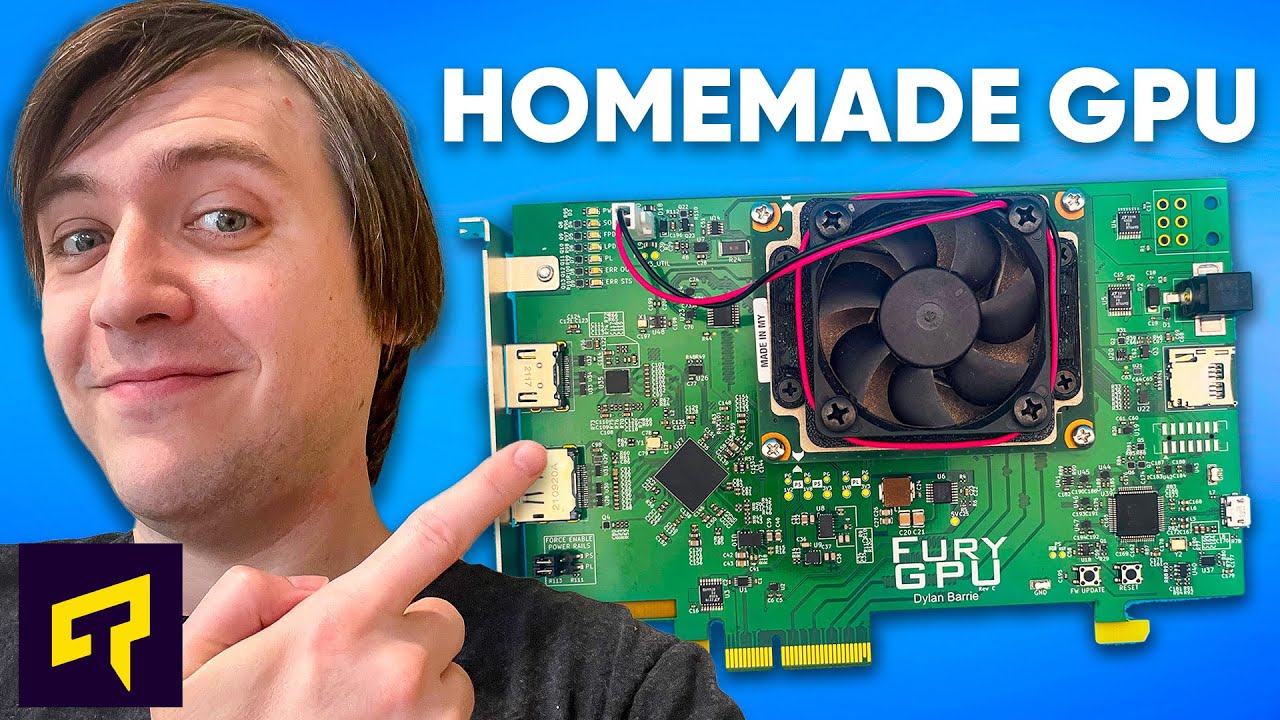
This Guy BUILT His Own Graphics Card!
0 up · 0 down · 0 ratings
Promos
Check out Paperlike at: paperlike.com Learn about Dylan Barrie's FuryGpu, a HOMEMADE GPU and graphics card! Leave a reply with your requests for future episodes. ► GET MERCH: lttstore.com ► GET EXCLUSIVE CONTENT ON FLOATPLANE: lmg.gg ► SPONSORS, AFFILIATES, AND PARTNERS: lmg.gg FOLLOW US ELSEWHERE --------------------------------------------------- Twitter: twitter.com Facebook: @LinusTech Instagram: @linustech TikTok: @linustech Twitch: twitch.tv
The video documents an extraordinary DIY achievement: building a fully functional graphics card from a custom FPGA. The project centers on Dylan Barry and his FuryGPU, which uses a Zynq Ultrascale+ FPGA as the core engine, paired with a dedicated board designed to host the FPGA and supply power and interfaces. The host explains how an FPGA can be configured with a hardware description language to render graphics, effectively turning the chip into a customizable GPU. Barry spent over three years from initial concept to a working architecture optimized for graphics rendering, starting with getting an image on a screen and progressively adding support for drawing polygons, texturing, and texture blending, all while dealing with the absence of trade secrets found in commercial GPUs. Once the FPGA design was solid, the project moved to hardware realization, requiring the layout of a custom PCB and the meticulous placement of more than 400 components like capacitors and resistors after PCB fabrication. The result is a FuryGPU card that, while reminiscent of older graphics cards in appearance, includes modern outputs and PCI Express X4 connectivity. The video also covers the software side, including the driver strategy which makes Windows treat the FuryGPU as a kernel mode display driver with an ability to switch modes to render frames, and a custom API akin to Vulkan to run legacy games such as Quake. Although performance targets and shader support are limited by FPGA constraints, the project stands as a proof-of-concept that a dedicated, handcrafted GPU can be built with enough time, patience, and soldering skill, and the team discusses future potential for shader enhancements and additional game ports."
Topics · technology · innovation · hardware · diy
Questions answered
- What is the FuryGPU built around and why is that choice significant?
- The FuryGPU centers on a Zynq Ultrascale+ FPGA which provides a flexible, reprogrammable core for graphics rendering. This choice allows custom hardware design tailored for graphics rather than relying on off-the-shelf GPUs, which explains the long development time but the unique, tailored capabilities.
- What major hardware and software challenges were overcome to make FuryGPU functional?
- Key challenges included designing a dedicated PCB layout with carefully matched trace lengths for PCIe signals, selecting appropriate power supplies for the FPGA, and assembling over 400 discrete components after PCB fabrication. Software-wise, creating a driver that Windows would recognize as a kernel mode display device and developing a custom API to render graphics on the FPGA were essential steps.